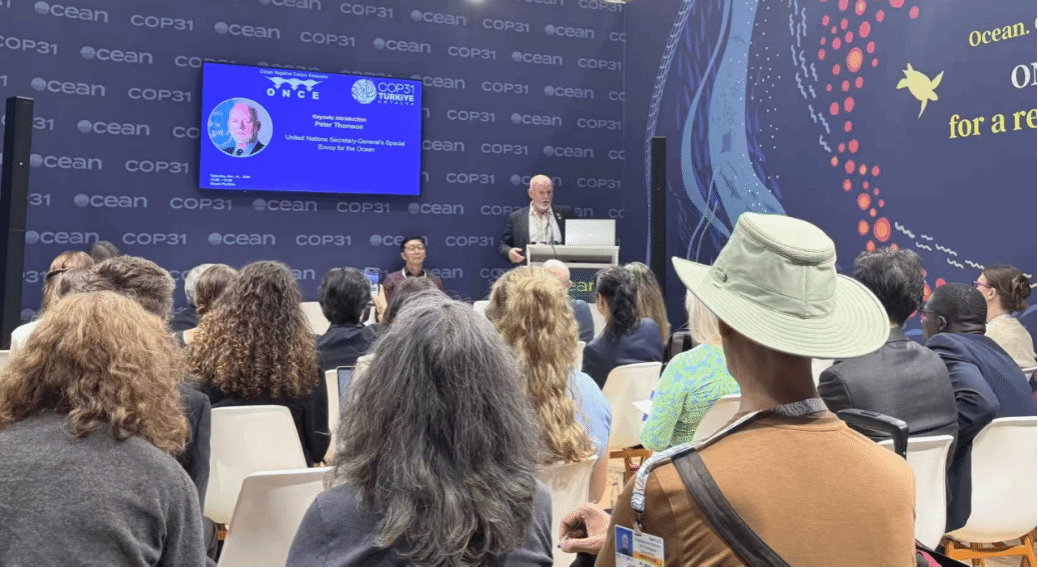
On November 14, 2026, the Ocean Pavilion in the Blue Zone of the 31st Conference of the Parties to the United Nations Framework Convention on Climate Change (COP31) hosted a side event titled “Ocean Negative Carbon Emissions: A Joint Effort from the Global ONCE Community”. Academician Nianzhi Jiao, Member of the Chinese Academy of Sciences, Fellow of the World Academy of Sciences (TWAS) and the American Academy of Microbiology, Chair Professor at Xiamen University, and Chairman and Chief Scientist of the Global Ocean Negative Carbon Emissions (Global ONCE) Programme, delivered a keynote address on “Ocean Negative Carbon Emissions for Carbon-Neutral Shipping”. He proposed using shipboard microalgae to utilize carbon dioxide from engine exhaust and nutrients from shipboard wastewater, turning ships from carbon emission sources into mobile carbon sinks. The session was moderated by Chuanlun Zhang, Chair Professor at the Southern University of Science and Technology. Peter Thomson, United Nations Secretary-General’s Special Envoy for the Ocean, attended and delivered remarks.
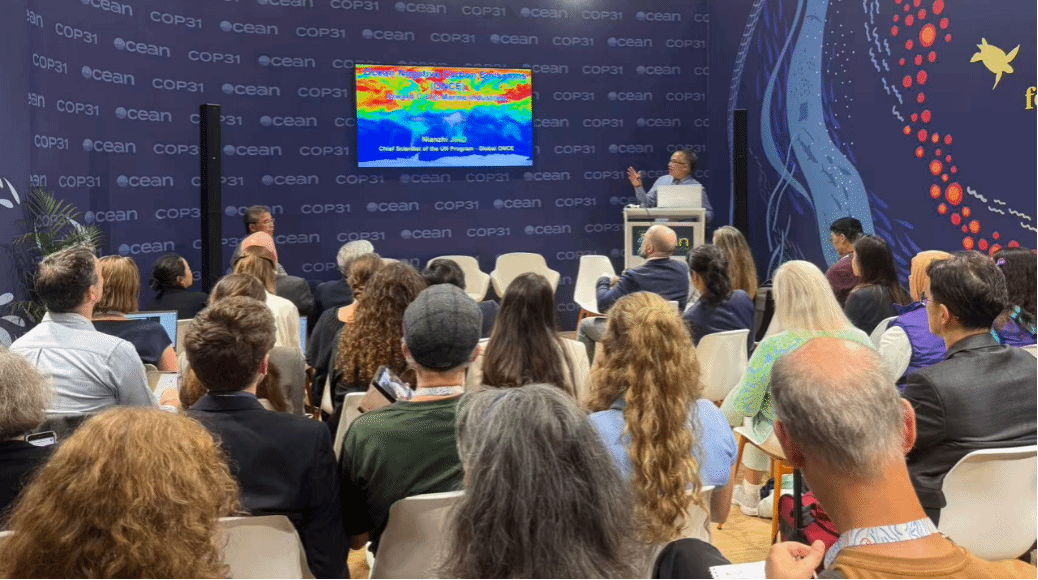
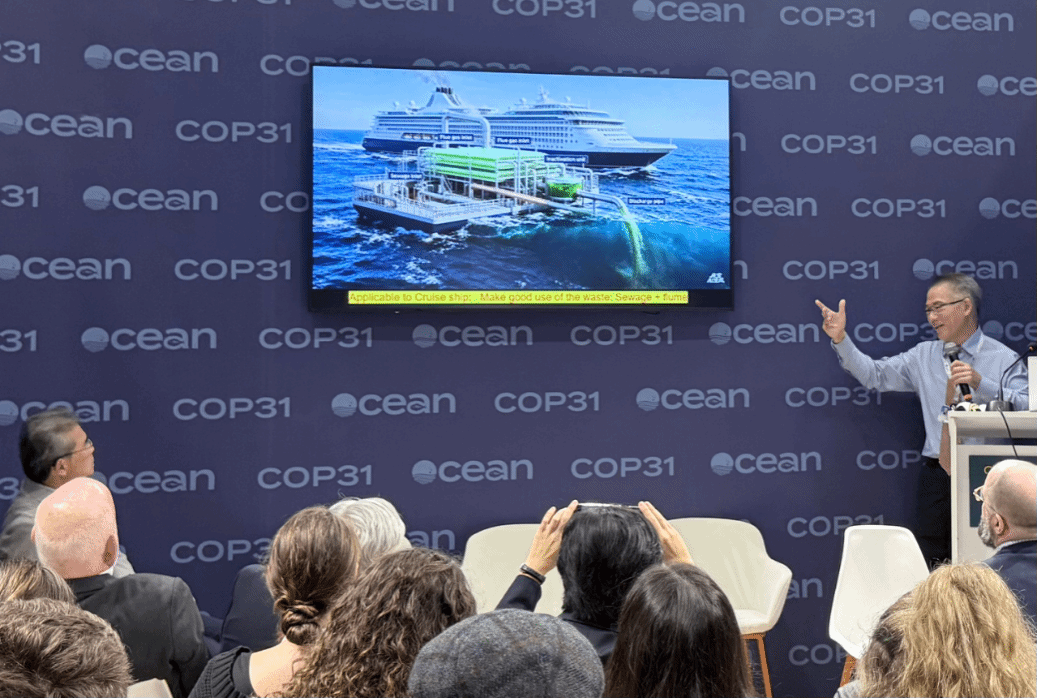
Shipping carries approximately 80 percent of global goods trade and emits around one billion tonnes of carbon dioxide each year. The International Maritime Organization (IMO) has set a goal of achieving net-zero greenhouse gas emissions from international shipping by or around 2050. Academician Jiao focused on carbon neutrality within the shipping system itself, using carbon dioxide from engine exhaust and shipboard wastewater as inputs for microalgae cultivation and connecting these processes with enhanced ocean carbon storage.
The proposal brings together ships, the ocean, and shore-based systems. Photobioreactors installed on deck cultivate microalgae using carbon dioxide from exhaust and nitrogen and phosphorus from shipboard wastewater. Photosynthesis fixes inorganic carbon, while pH regulation increases alkalinity. Following biomass inactivation and environmental safety monitoring, the material enters pathways for onshore collection or deep-ocean carbon storage. These safeguards prevent foreign living organisms from entering the marine environment. Together, exhaust utilization, wastewater resource recovery, and ocean carbon storage form an integrated process.
The approach centers on the Microbial Carbon Pump (MCP) and integrates the Biological Carbon Pump (BCP), the Carbonate Counter Pump (CCP), and the Solubility Carbon Pump (SCP) into the four-pump coupling mechanism known as BCMS. With MCP at its core, the coupled pumps connect carbon fixation, transformation, and long-term storage, applying original research on ocean carbon cycling to the challenge of carbon-neutral shipping.
In his remarks, Peter Thomson recognized Academician Jiao’s team for its research on enhancing ocean carbon sinks through alkalinity regulation of cruise ship wastewater. He emphasized the value of this MCP-based approach for maritime decarbonization and small island developing states. Thomson said the project would work with Peace Boat on tests during actual voyages, bringing together scientific and maritime partners from Asia, Europe, and the Americas. He also pledged to follow the technical trials, environmental assessments, and governance progress, and to bring the project’s results into international ocean and climate dialogue.
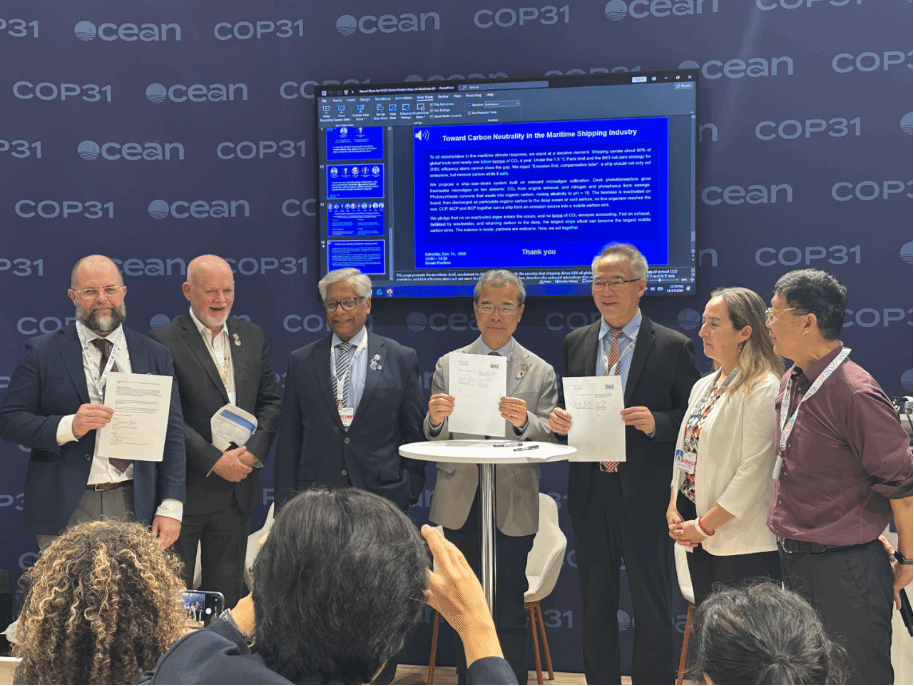
The subsequent panel discussion featured Kilaparti Ramakrishna, Senior Advisor at the Woods Hole Oceanographic Institution, Camila Fernández, Research Scientist at the French National Centre for Scientific Research, Jay T. Lennon, Chair of the Applied and Environmental Microbiology Scientific Unit of the American Society for Microbiology, and Tatsuya Yoshioka, founder of Peace Boat. Participants reached a shared understanding on the community initiative “Toward Carbon Neutrality in the Maritime Shipping Industry”. A memorandum of understanding was signed to advance international joint research, demonstrations aboard ships, and cooperation with industry.
Carbon neutrality in maritime shipping is among the five particularly difficult areas of decarbonization and a major challenge for the global green transition. Academician Jiao’s team has presented a scientific solution that can transform ships from emission sources into mobile carbon sinks. By connecting original scientific theory with environmental engineering and maritime practice, Ocean Negative Carbon Emissions also opens new opportunities for mariculture, wastewater treatment, and related industries, contributing Chinese scientific insight and solutions to greener global shipping and sustainable development of the ocean economy.
Contributed by: Zhibin Xu
Edited by: Yang Liu
Reviewed by: Chen Hu