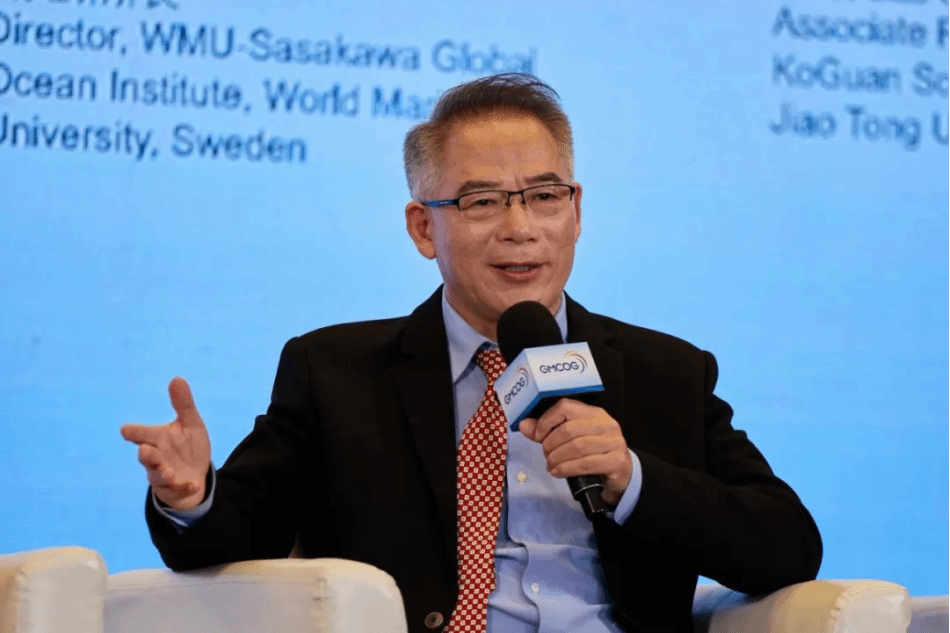
At the 7th Symposium on Global Maritime Cooperation and Ocean Governance in Sanya, Hainan, on November 8, 2026, Nianzhi Jiao, Member of the Chinese Academy of Sciences, Fellow of the World Academy of Sciences (TWAS) and the American Academy of Microbiology, Chair Professor at Xiamen University, Chairman and Chief Scientist of the Global Ocean Negative Carbon Emissions (Global ONCE) Programme, outlined approaches to strengthening marine carbon sinks while protecting biodiversity. Speaking during a discussion on marine biodiversity conservation, he highlighted opportunities to align Ocean Negative Carbon Emissions with ecological protection.
The symposium, held from November 6 to 8, brought together more than 400 participants from over 30 countries and regions. It was jointly organized by the Huayang Center for Maritime Cooperation and Ocean Governance, the National Institute for South China Sea Studies, the China Ocean Development Foundation, and the Hainan Free Trade Port Research Institute, with support from the Chinese Language Global Programming Center of China Media Group (CMG). Participants included the Governor of Hainan Province, China’s Special Envoy for Climate Change, relevant government officials from Indonesia and the Maldives, and Singapore’s former Minister for Foreign Affairs.
The Agreement under the United Nations Convention on the Law of the Sea on the Conservation and Sustainable Use of Marine Biological Diversity of Areas Beyond National Jurisdiction (BBNJ Agreement) entered into force on January 17, 2026. Through provisions covering marine genetic resources and benefit-sharing, area-based management tools, environmental impact assessments, and capacity building, the Agreement provides a governance framework for protecting species, habitats, and ecological processes on the high seas. China has formally applied to host the Agreement’s secretariat in Xiamen. As the headquarters of the ONCE Programme, Xiamen also brings together scientific expertise in marine carbon cycling and ecological monitoring, providing a foundation for connecting marine biodiversity conservation with international governance cooperation.
Academician Jiao outlined three practical pathways pursued by ONCE under the guiding principle of biodiversity conservation. The first integrates land-sea coordination to reduce emissions and enhance carbon sinks. By reducing pollutant discharges and excessive nutrient inputs into coastal waters, this pathway can alleviate eutrophication and hypoxia, improve estuarine and coastal habitats, and sustain marine carbon sink functions. The second combines ecological restoration in mariculture areas with integrated carbon sink enhancement. Ecological engineering powered by clean energy can improve water quality and benthic habitats, facilitate the recovery of biological communities in degraded marine areas, and strengthen carbon sink functions. The third explores ocean alkalinity enhancement, including the alkalization of treated wastewater effluent, to help transform wastewater treatment systems from carbon sources into carbon sinks. This pathway also involves assessing the potential effects of changes in seawater chemistry on plankton, shellfish, and other marine organisms to safeguard ecological safety. It further explores participation in carbon markets through verifiable carbon sink enhancement, creating opportunities for environmental management authorities to evolve from major expenditure centers into entities capable of generating revenue.
To address the shared needs of carbon sink enhancement and biodiversity conservation, ONCE continues to advance five major missions encompassing theoretical innovation, platform development, demonstration projects, international cooperation, and talent development and communication. These efforts help translate research on microbial ecological mechanisms, biological community monitoring, and habitat restoration into technological demonstrations and internationally shared practices. In international standardization, the project initiated by ONCE on Ocean Negative Carbon Emissions and carbon neutrality (ISO 25283-1) has been approved by the International Organization for Standardization (ISO) and entered the final international standard drafting stage in 2026. The initiative seeks to establish a common technical basis for carbon sink accounting, monitoring and reporting, and international cooperation. By integrating biodiversity monitoring and ecological impact assessment, it also promotes simultaneous attention to carbon sink enhancement and ecological safety.
Drawing on the Triple REAL principles advocated by ONCE, Academician Jiao emphasized that carbon sink enhancement activities should be guided by ecological ethics, legal compliance, and responsible management, with close attention to changes in marine biological communities and habitats. The experience gained from ecological monitoring, impact assessment, and technology sharing in ONCE’s coastal research and demonstration activities offers approaches that may inform high seas conservation, environmental impact assessment, capacity building, and marine technology transfer under the BBNJ Agreement. These approaches can help advance climate action and biodiversity conservation in a coordinated manner.
Marine biodiversity underpins the carbon sink functions of ocean ecosystems and provides an important basis for assessing the long-term effectiveness and ecological suitability of Ocean Negative Carbon Emissions technologies. Academician Jiao and the ONCE team integrate species and habitat conservation throughout their work on emissions reduction and carbon sink enhancement, ecological restoration, and ocean alkalinity enhancement. Through sustained monitoring, ecological impact assessment, international standards, and open cooperation, these efforts support the translation of scientific advances into global ocean governance and provide scientific and technological support for implementing the BBNJ Agreement and for China’s participation in global biodiversity conservation. During the symposium, the Chinese Language Global Programming Center of CMG also conducted a special interview with Academician Jiao.