On November 9, 2026, Nianzhi Jiao, Member of the Chinese Academy of Sciences, Fellow of the World Academy of Sciences (TWAS) and the American Academy of Microbiology, Chair Professor at Xiamen University, Chairman and Chief Scientist of the Global Ocean Negative Carbon Emissions (Global ONCE) Programme, presented China's approaches to climate mitigation and ecosystem sustainability at a COP31 China Pavilion side event in Antalya, Türkiye. Speaking at “Global Open Class: Green Transformation in Action”, he explained the scientific potential of Ocean Negative Carbon Emissions to support global green transition.
The event was jointly hosted by the United Nations Institute for Training and Research (UNITAR) and China Global Television Network (CGTN). Gao Li, Vice Minister of Ecology and Environment and Head of the Chinese Delegation, delivered remarks at the China Pavilion opening ceremony. The Director of the Center for Environmental Education and Communications under the Ministry of Ecology and Environment also addressed the side event, while UNITAR Executive Director Michelle Gyles-McDonnough contributed remarks by video.
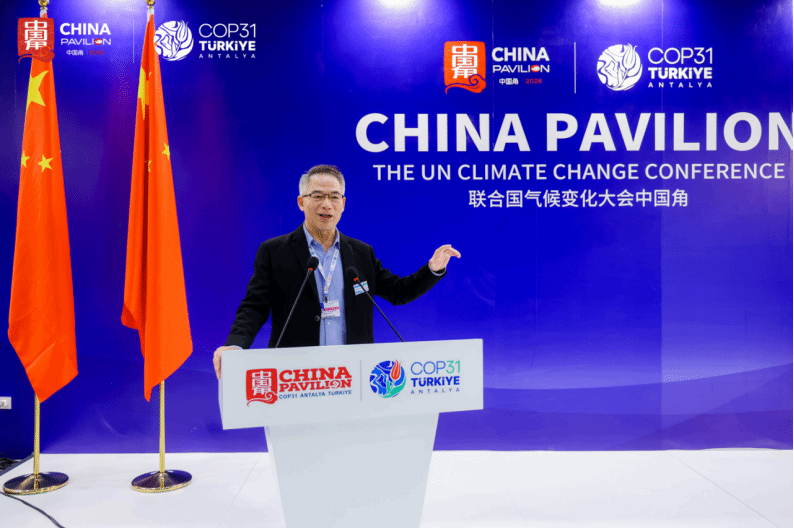
Academician Jiao introduced the theory of the Microbial Carbon Pump (MCP), explaining how microorganisms transform organic carbon into recalcitrant dissolved organic carbon and facilitate its long term preservation, as well as how this process relates to the biological carbon pump, carbonate pump, and solubility pump. Under suitable environmental conditions, these carbon pumps may work together to enhance carbon sequestration, opening new scientific possibilities for Ocean Negative Carbon Emissions. Drawing on highly productive estuarine and coral reef waters, the presentation explored how coastal blue carbon systems can maintain net carbon uptake, how mariculture can combine pollution control with carbon sink enhancement, and whether wastewater treatment plants can be transformed from carbon sources into carbon sinks. These cases highlight the central scientific rationale for Ocean Negative Carbon Emissions, which links carbon cycling mechanisms and ecological constraints with improvements in environmental quality and carbon sink function while requiring carbon removal benefits to remain verifiable and effective over time.
Scalable climate action requires clear answers to how carbon sink enhancement should be measured and how outcomes across different marine regions can be compared. The international standardization project on Ocean Negative Carbon Emissions and carbon neutrality, ISO 25283-1, initiated by Global ONCE, was approved by the International Organization for Standardization (ISO) in 2024 and has entered the international standard drafting stage. It seeks to provide a common language through which countries can communicate and assess marine carbon sink enhancement practices. The presentation also introduced the Triple REAL framework, designed to be compatible with the Agreement under the United Nations Convention on the Law of the Sea on the Conservation and Sustainable Use of Marine Biological Diversity of Areas Beyond National Jurisdiction (BBNJ Agreement). The framework calls for solutions that are ethically appropriate, scientifically sound, and legally compliant, implementation pathways that are feasible, reliable, and promising, and governance that follows international rules and assigns responsibility. In this way, the assessment of Ocean Negative Carbon Emissions extends beyond conventional monitoring, reporting, and verification to encompass legal, ethical, and biodiversity considerations, strengthening the ecological and governance foundations of carbon sink enhancement.
In linking science with policy, Academician Jiao presented a policy brief released through a United Nations platform in support of Sustainable Development Goals (SDGs) 13, 14, and 17. The brief proposes examining a higher minimum pH requirement for treated wastewater discharges, including a possible change from below 6.0 to above 8.0, to alleviate coastal acidification and related environmental risks while creating favorable conditions for enhancing coastal carbon sinks. This policy proposal translates research findings on marine carbon cycling into specific environmental governance questions and directions for improving standards, demonstrating the practical value of original scientific research from China for climate governance and marine ecological protection.
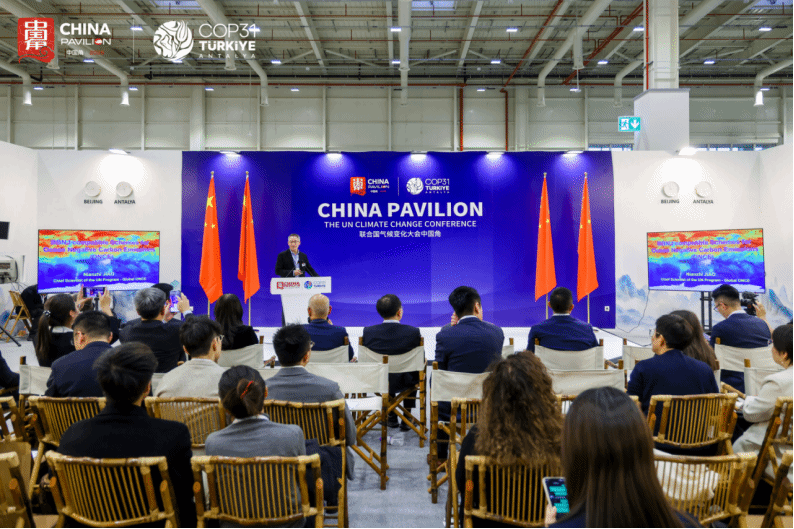
In recent years, Global ONCE has sustained academic exchange through international platforms including the United Nations Ocean Conference, the United Nations Science, Technology and Innovation Forum, the World Laureates Forum, the Davos Forum, the Science and Technology in Society (STS) Forum, and the Environmental, Social and Governance (ESG) Global Leaders Summit. Through United Nations policy briefs, Open Science Conferences, and the globally accessible course “Habitable Earth”, the Programme has helped bring scientific findings on Ocean Negative Carbon Emissions into international policy dialogue and public science education. This Global Open Class connected scientific research, local practice, and dialogue with global media, further expanding the pathways through which scientific understanding can lead to societal action.
From the development of the Microbial Carbon Pump theory to the advancement of international standards and United Nations policy initiatives, Ocean Negative Carbon Emissions now connects fundamental research, ecological practice, and global governance. It offers a new perspective on marine carbon cycling alongside approaches that countries can test, refine, and share. Through open cooperation that brings original scientific achievements from China to the world, Global ONCE is connecting Chinese scientific innovation with global climate action and offering an approach that supports carbon neutrality together with the ecological sustainability of the ocean.