On February 23, 2026, the Intergovernmental Oceanographic Commission of UNESCO (UNESCO-IOC) released the landmark report Integrated Ocean Carbon Research: a vision primed for implementation (IOC-R). Compiled by 72 researchers from 23 countries, this pivotal publication underscores the ocean’s irreplaceable role in the global carbon cycle, identifies critical knowledge gaps in current research, and delivers a clear roadmap for governments, research institutions, and the public to engage in climate governance.
As Earth’s largest active carbon sink, the ocean absorbs a substantial portion of anthropogenic CO₂, serving as a natural buffer against climate change. Yet, fundamental questions remain unanswered: How will the ocean carbon sink potential evolve under a changing climate? How do biological processes regulate the carbon cycle? What are the dynamics of carbon exchanges across the land-ocean-ice continuum? Addressing these uncertainties, the report outlines five core research priorities:
3.a Evolution of the ocean carbon sink under a changing climate
3.b The changing role of biology in the ocean carbon cycle
3.c Carbon exchanges across the land-ocean-ice continuum
3.d The impact of ocean industrial processes on the ocean biological carbon cycle
3.e Future changes in the carbon cycle from deliberate ocean-based climate interventions
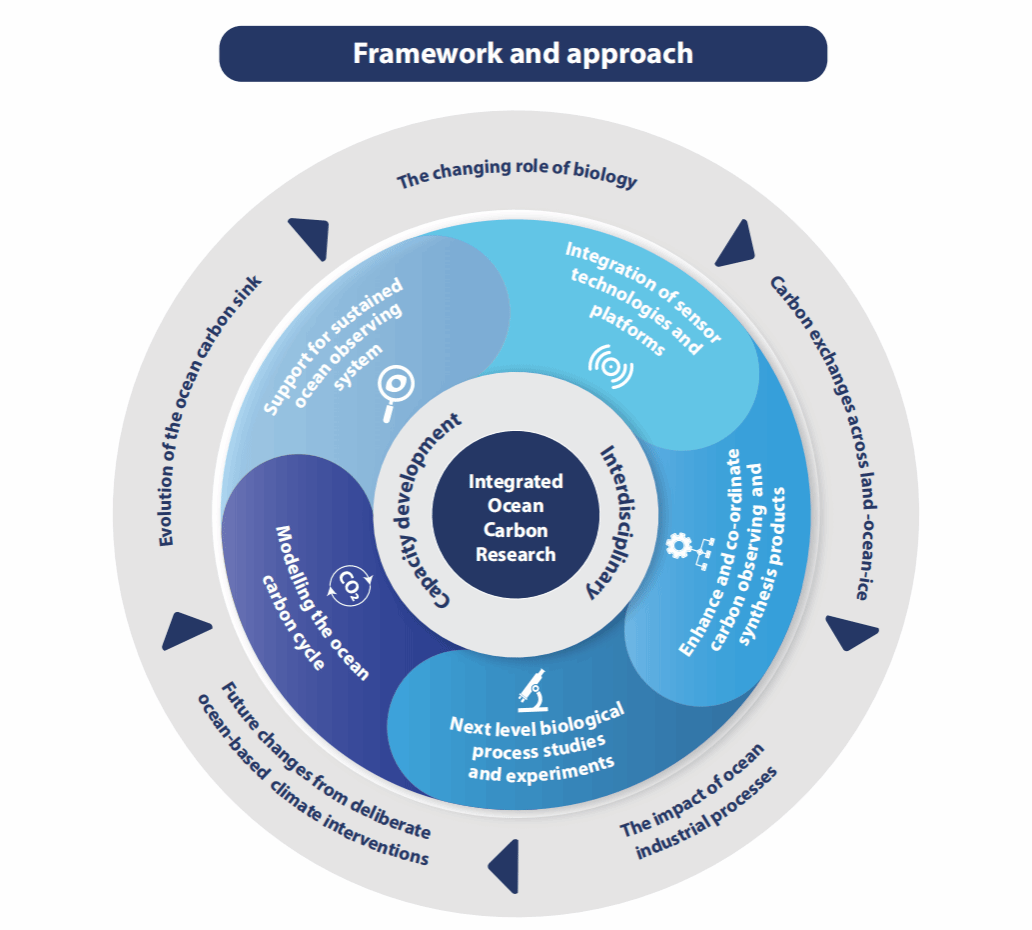
Figure. Overview of the five identified focus areas for integrated ocean carbon research, prioritised approaches and a framework of interdisciplinarity and capacity development.
It further presents a systematic pathway from knowledge identification to actionable solutions, spanning observational systems, technological integration, data synthesis, advanced biological experimentation, and carbon cycle modeling.
Several members of the ONCE program were deeply involved in shaping the report, with Chief Scientist Professor Jiao Nianzhi contributing to key chapters including 3.b The changing role of biology in the ocean carbon cycle, 3.e Future changes in the carbon cycle from deliberate ocean-based climate interventions, 4.a Support for sustained ocean carbon observing systems, and 4.d Next level biological process studies and experiments. His contributions provided critical scientific underpinnings for the report’s implementation framework, particularly in advancing understanding of biological mechanisms in the ocean carbon cycle, practices of ocean-based climate interventions, the development of ocean carbon observing systems, and the upgrading of biological process research.
This report not only consolidates the latest scientific understanding but also aligns with the strategic goals of the ONCE program, reinforcing the importance of integrated ocean carbon research in informing global climate policy and fostering international collaboration toward a sustainable future.
Original link:
Integrated Ocean Carbon Research: a vision primed for implementation