On the occasion of the 30 Conference of the Parties (COP30) to the United Nations Framework Convention on Climate Change in Belém, the Global Ocean Negative Carbon Emissions (Global ONCE) Program—an international big science program initiated and led by China under the UN Decade of Ocean Science, together with the China Association for Science and Technology (CAST) United Nations’ Consultative Committee on Sustainability of Marine Ecosystems (CCSME), successfully convened the high-level side event “The Ocean's Turn: Delivering a Science-Based Action Plan for Negative Emissions at COP30”.
Building upon nearly fifteen years of solid scientific research and practical exploration, and guided by the “Triple REAL” vision, the ONCE Program released a series of significant outcomes covering scientific theory, technological pathways, market mechanisms, and governance frameworks during the side event. The Program also issued an initiative to the international community, emphasizing the need to deepen science-oriented actions and promote the transition of ocean negative carbon emissions from theory to practice. This marks a crucial leap for the Chinese-led ocean negative emissions research, evolving from original scientific breakthroughs to the construction of systematic solutions and the shaping of global rules, charting a clear, feasible, and promising “Blue Path” for global climate governance.
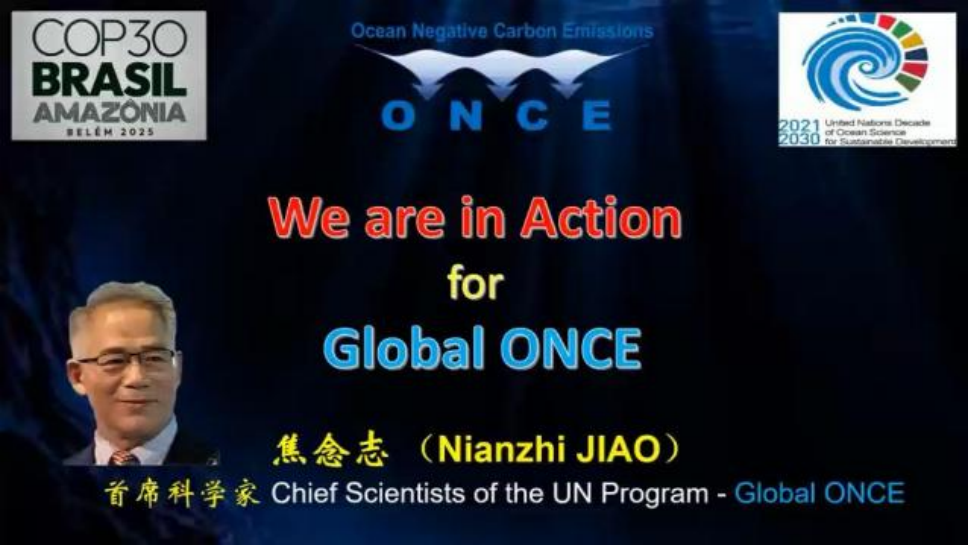
The side event was held at the COP30 China Pavilion on November 17, 2025, moderated by Kilaparti Ramakrishna (Rama), Director of the Marine Policy Center at the Woods Hole Oceanographic Institution (USA), co-moderated by Chuanlun Zhang, Chair Professor at Southern University of Science and Technology and Head of the International Collaboration Department of Global ONCE. Opening remarks were delivered by Shidong Yan, Director of the Center for Environmental Education and Communications, Ministry of Ecology and Environment of China, and Peter Thomson, UN Secretary-General's Special Envoy for the Ocean. The keynote speech was given by Nianzhi Jiao, Chief Scientist of Global ONCE and Academician of the Chinese Academy of Sciences. Panelists included: Alexander Turra, Coordinator of the UNESCO Chair for Ocean Sustainability at the Institute of Oceanography, University of São Paulo, Brazil; Camila Fernández, CNRS and Director of the Center of Oceanographic Research in the Eastern South Pacific COPAS Coastal as well as member of the Scientific Council for Climate Change in Chile and the ocean Institute in Concepción, Chile; Catalina Reyes, Founder and Director of the Colombia Ocean-Climate Innovation Hub at Universidad de los Andes, Colombia; and Han Dolman, Director of the Royal Netherlands Institute for Sea Research, the Netherlands.
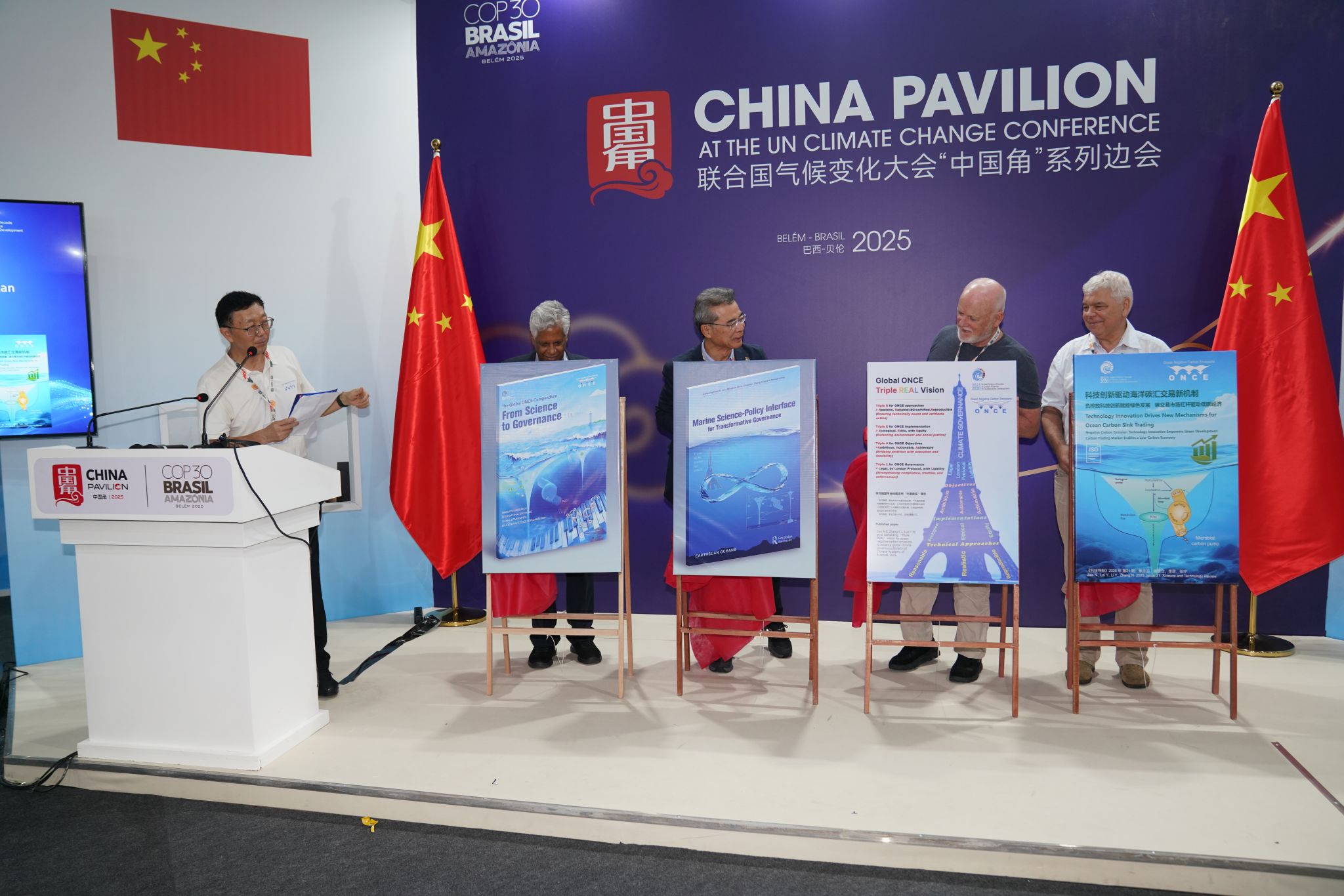
This side event was co-hosted by the Global ONCE Program and the China Association for Science and Technology (CAST) United Nations’ Consultative Committee on Sustainability of Marine Ecosystems (CCSME). Guiding organizations included: the Department of International Cooperation, Ministry of Science and Technology of China; the International Science and Technology Cooperation Center, Ministry of Science and Technology of China; the Department of Marine Ecology and Environment, Ministry of Ecology and Environment of China; the Department of Science and Technology Development, Ministry of Natural Resources of China; and the China Centre for International Science and Technology Exchange. Participating organizations included: the China Association for Science and Technology Consultative Committee on Sustainability of Marine Ecosystems; Woods Hole Oceanographic Institution (USA); University of São Paulo (Brazil); University of Concepción (Chile); Universidad de los Andes (Colombia); and the Royal Netherlands Institute for Sea Research (the Netherlands).
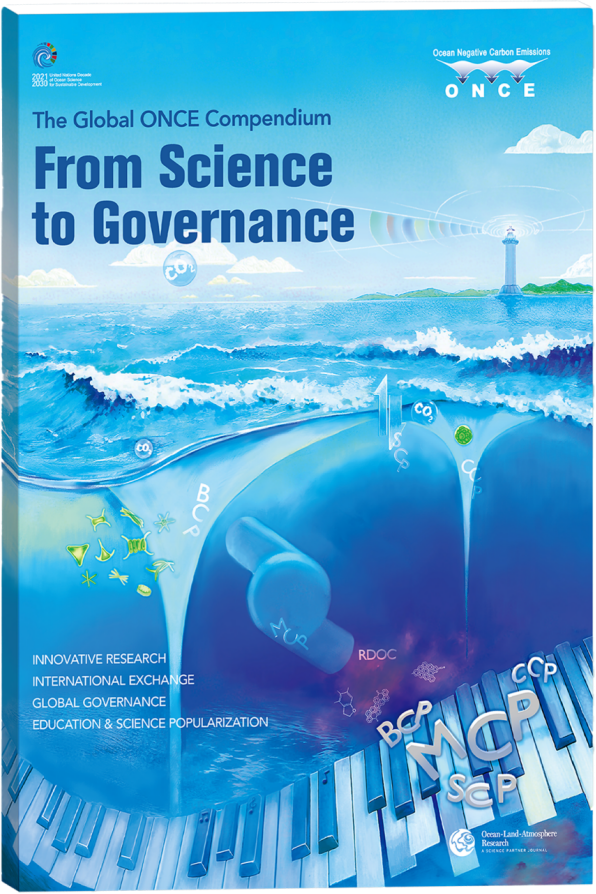
Outcome 1: Official Release of “The Global ONCE Compendium: From Science to Governance”, Constructing a Global Action Plan for Ocean Negative Emissions
As a foundational document for the ONCE Program, the “The Global ONCE Compendium: From Science to Governance” was officially launched globally at the side event. The Compendium systematically elaborates the critical role of the ocean in climate governance. Supported by the original “Microbial Carbon Pump (MCP)” theory from Chinese scientists, it comprehensively proposes and elucidates the “BCMS Four-Pump Integration” carbon sequestration mechanism, constructing a systematic framework from theoretical innovation to governance practice. The “BCMS Four-Pump Integration” strategy aims to build a stable, efficient, and ecologically sustainable marine carbon sink ecosystem by synergizing the Microbial Carbon Pump (MCP), the Biological Carbon Pump (BCP), the Carbonate Counter Pump (CCP), and the Solubility Carbon Pump (SCP). This book provides a comprehensive roadmap covering scientific principles, technological pathways, and governance norms for global policymakers, researchers, engineers, and ocean managers. The content of this Compendium is divided into six sections. The first section “From Science to Solutions: Ocean Negative Carbon Emissions—A Roadmap for a UN Ocean Decade-Endorsed Initiative” sets the foundation for the other five, which outlines the vision and mission of the initiative; The other sections include the Global Ocean Negative Carbon Emissions Constitution, Terms of Reference for Committees of the Global Ocean Negative Carbon Emissions Program, Global ONCE Code of Professional Conduct, Highlights of Global Ocean Negative Carbon Emissions Program Approaches and a Code of Conduct for Research, and Global ONCE Fellows Program. These texts collectively establish a transparent, standardized, and equitable international cooperation framework, providing institutional safeguards for large-scale, multi-stakeholder ocean negative emission actions.
Outcome 2: Release of “Marine Science-Policy Interface”, Building a Critical Bridge from Science to Governance
The pre-print of the monograph “Marine Science-Policy Interface” was released at this side event. Focusing on how to effectively connect marine science and policy-making under the “Ocean Decade” framework, this monograph systematically explores the key mechanisms and pathways for science to support decision-making. As a core vehicle for realizing the “Science-Policy-Practice” synergy of the Global ONCE Program, the book uses the “Microbial Carbon Pump” theory and the “BCMS Four-Pump Integration” pathway as its scientific basis to construct a transdisciplinary epistemology and operational framework, aiming to fully implement the Global ONCE’s “Science-based Policymaking, Policymaking for Scientific development, Scientific development for Society (SP-PS-SS)” philosophy. The knowledge collaboration mechanisms and decision-making tools proposed in the book will effectively address the core challenge of integrating science into policy during the process of technological standardization and scaling. Through specific case studies, the book will vividly demonstrate how the “Marine Science-Policy Interface (MSPI)” facilitates the regional implementation of the Global ONCE “Triple REAL” framework, providing replicable and scalable interface coordination solutions that accelerate the translation of ocean negative emissions technologies from laboratory research to large-scale global governance applications. The release of this pre-print is expected to boost the efficacy of global marine climate action and strengthening the resilience of global marine governance systems in combating climate change.

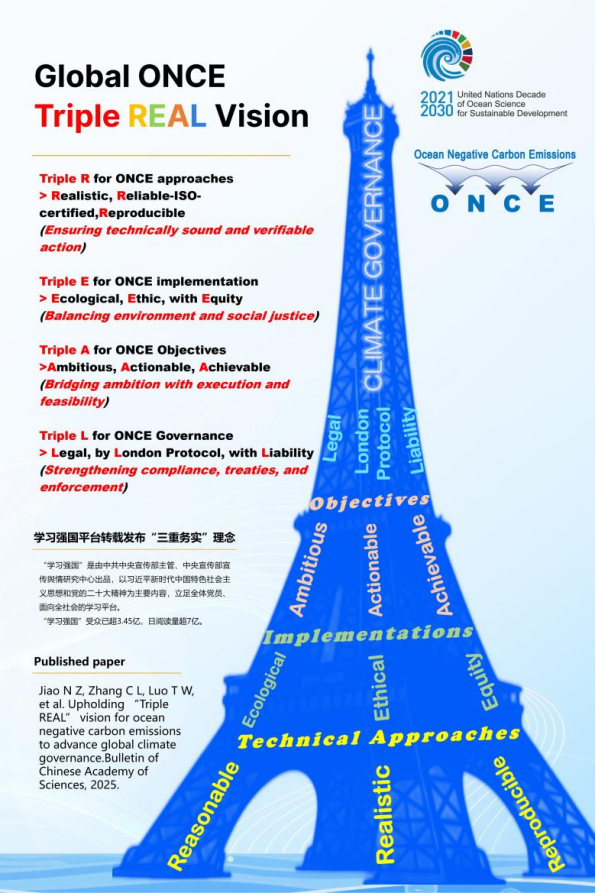
Outcome 3: Establishment of the “Triple REAL” Vision, Comprehensively Upgrading the Ocean Climate Governance Framework
The core guiding vision of the Global ONCE Program—the “Triple REAL” vision—was first introduced at the Third UN Ocean Conference (2025, Nice, France), establishing a systematic framework integrating technical solutions, implementation principles, expected goals, and governance safeguards. This vision specifically comprises the following four dimensions: The 3R Technical Solutions (Realistic, Reliable-ISO-certified, Reproducible), ensuring a solid and reliable scientific foundation; The 3E Implementation Principles (Ecological, Ethical, with Equity), instilling social-ethical connotations into carbon dioxide removal activities and ensuring procedural fairness and justice; The 3A Expected Goals (Ambitious, Actionable, Achievable), achieving an organic unity of ambition and pragmatism; and The 3L governance framework (Legal, by London Protocol, with Liability), providing binding legal and liability guarantees. The “Triple REAL” vision transcends the conventional scope of the “Monitoring, Reporting, Verification (MRV)” principles, as it not only focuses on the quantitative monitoring of ocean negative carbon emissions but also emphasizes the responsibility, sustainability, and international acceptability of the entire process, thereby laying a solid value foundation for the implementation and promotion of ocean negative emissions. The core content of this vision has been formally published in 2025 in the Bulletin of the Chinese Academy of Sciences under the title “Upholding the 'Triple REAL' vision for ocean negative carbon emissions to advance global climate governance”, marking its significant influence in both scientific and policy circles.
Outcome 4: Innovative Proposal of a “Process-based Certification” Mechanism, Solving the Marketization Challenge of Marine Carbon Sinks
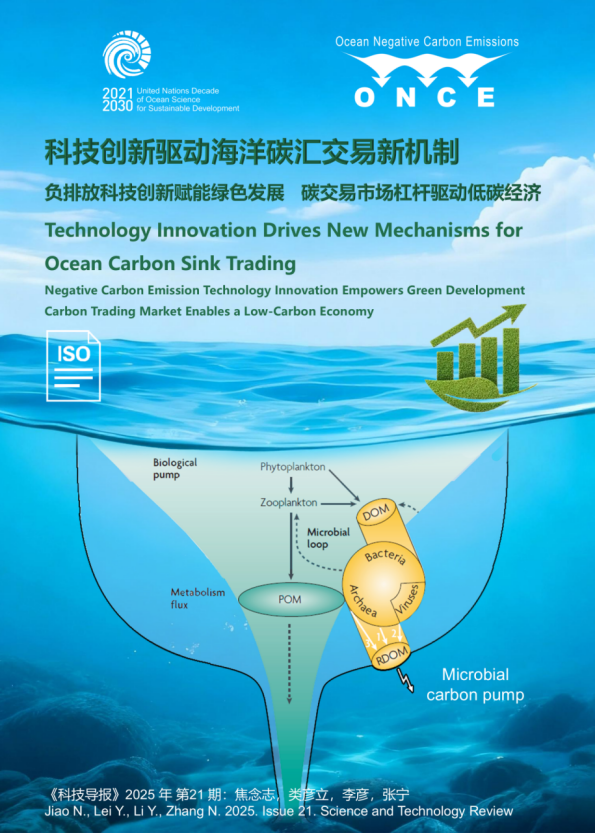
Currently, the global carbon market is transitioning from the “emission allowance era” to the “carbon credit era”. In this context, how to transform the ocean from a “neglected giant carbon reservoir” into “verifiable, tradable additional carbon sinks” has become a core issue in driving the global achievement of net-zero goals. To address this challenge, the Global ONCE Program has conducted systematic research from multiple dimensions including scientific principles, monitoring and methodology, carbon credit and market mechanism analysis, and trading mechanism design. The research indicates that the traditional model relying on “precise measurement of tons of carbon” has significant limitations in the complex marine environment. Consequently, Global ONCE innovatively proposes a “Process-based Certification mechanism that transcends direct physical carbon sink measurement”: by establishing a “whitelist” of negative emission activities, the focus of carbon credit generation shifts from the difficult-to-measure directly “carbon sink outcome” to the scientifically verifiable and continuously monitorable “carbon sink enhancement activity process”. This mechanism not only provides a feasible pathway for the marketization of marine carbon sinks but also deeply explores the attribute positioning of ocean negative emissions as a “global public good” from the perspectives of governance and rules. The related research findings, titled “Technology Innovation Drives New Mechanisms for Carbon Sink Trading”, have been published in Science & Technology Review, 2025, Vol. 21, providing important theoretical support and institutional reference for carbon market transformation.
Looking Ahead: Ushering in a New Phase of Ocean-Based Climate Governance
The systematic release of this series of outcomes on the COP30 platform fully demonstrates that the Global ONCE Program now possesses comprehensive capabilities across all dimensions, from scientific and technological innovation to the shaping of international rules. Guided by the “Triple REAL” vision, through leading the establishment of the ISO/TC8/WG15 “Ocean Negative Carbon Emissions and Carbon Neutrality” international standardization working group, constructing an efficient “Marine Science-Policy Interface”, and promoting the replicable “Process-based Certification” carbon market mechanism, the ONCE Program is progressively translating scientific consensus and systematic solutions originating from China into global consensus and concerted action. These advancements not only provide indispensable scientific support and institutional reference for the world to achieve carbon neutrality goals on schedule but will also continue to contribute Chinese wisdom and strength to building a more equitable, transparent, inclusive, and effective new order for global climate governance.
About the Global ONCE Program
The Global Ocean Negative Carbon Emissions (Global ONCE) Program is a UN Ocean Decade endorsed program led by Nianzhi Jiao, Academician of the Chinese Academy of Sciences and Professor at Xiamen University. Addressing the needs of global climate governance and carbon neutrality, the Program is grounded in the original “Microbial Carbon Pump (MCP)” theory. Through multidisciplinary integration, it has constructed a “Four-Pump Integration” theoretical framework for ocean negative carbon emissions. The Global ONCE Program systematically promotes targeted negative carbon emissions in designated “problem” marine areas using scientifically, ethically, and legally sound approaches, thereby generating tangible new quality productive forces. Its core concepts and technological pathways have been incorporated as important ocean-based solutions into the 2019 IPCC Special Report and the 2021 Integrated Ocean Carbon Research Report by the UN Intergovernmental Oceanographic Commission (IOC). The International Organization for Standardization (ISO) has also specifically established an international standards working group led by Global ONCE to promote global standardization of ocean negative carbon emissions and carbon neutrality. Through cutting-edge theoretical leadership, ecological engineering demonstration, and international scientific education, the ONCE Program has garnered positive responses worldwide. Currently, 104 research institutions from 35 countries are participating, with several Global ONCE regional hubs established in Asia, the Americas, and Europe, gradually building a global cooperation network.